Litesport - Description
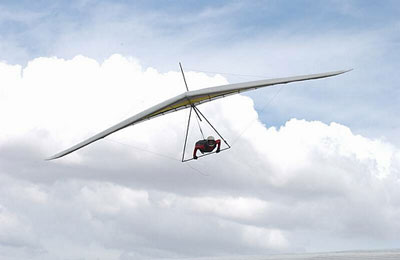
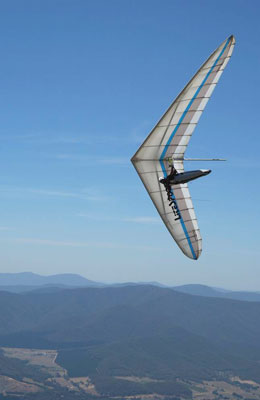 The Moyes Litesport is arguably the best king posted hang glider on the market. Designed by Gerolf Heinrichs, the Litesport has evolved out of the knowledge and experience base of the Litespeed and performs similarly to a non-king posted glider, while handling like an intermediate glider. The Moyes Litesport is arguably the best king posted hang glider on the market. Designed by Gerolf Heinrichs, the Litesport has evolved out of the knowledge and experience base of the Litespeed and performs similarly to a non-king posted glider, while handling like an intermediate glider.
Characteristics overview
- suitable for competitive or recreational flying.
- superior handling, more responsive, easy to turn, easier to straighten
- sophisticated, but easy to operate VG system with one luff line and single dive stick for reduced drag and weight
- easy to handle with a comparable glide with most non-king posted gliders
- diverse range afforded by VG and G-string systems.
- VG off = loose, flexible wing with raised tailing edge for launches, landing and thermalling
- VG applied = tight, flat sail for high speed glides.
- low wing tip inertia due to low weight
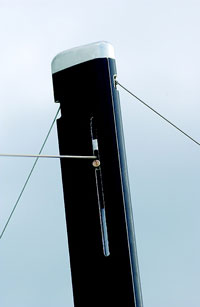
- Automatic compensation: the luff line is linked to the top side wire, the top side wire travels up the kingpost when the VG is loose which causes the luff line to be automatically compensated. The certification testing showed excellent pitch stability readings with this innovative system.
- Side wires: the top side wire runs through a slider in the kingpost which keeps the side wires tensioned at all VG settings, this enables the glider to have taut instead of loose side wires on take off and a powerful VG
Characteristics Overview
- competition or cross country performance
- 3 sizes to suit all pilot weights
- inlaid sail design for improved handling and performance
Technical Overview - Standard
- durable, white, 205 sq Dacron mainsail
- full 7075 series aluminium air frame
- aerofoil uprights and a round speed bar
Technical Overview – Carbon fibre Options
- carbon fibre speed bar
- carbon fibre outer leading edges
- carbon fibre dive struts
- carbon fibre inner leading edges
- carbon fibre keel
Technical Overview - Sail Options
- Dacron Dimension Polyant 205 sq
- Code Zero Inlaid Sail
- PX 05 TI02 IT-Internal Taffeta- Titanium Oxide Inlaid sail
- undersurface has three panels of Dacron, and can be custom coloured to your requirements
- ** New: The new PX 05 for the mainsail has an internal taffeta and extra fine film of mylar on the inside of the cloth making it the perfect weight for a mainsail with excellent handling and durability
 |
 |
| The G-String Compensation system - as the VG is pulled on, the top side wires are lowered, hence lowering the trailing edge via the single luff line. |
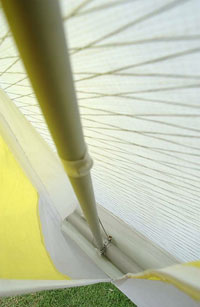
The advanced dive stick design takes advantage of the stiff leading edge, providing more effective support. |
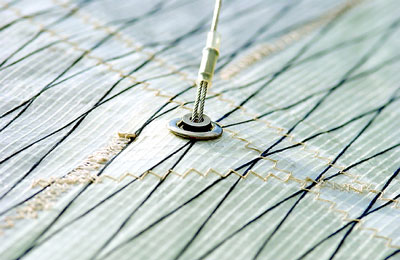
The single luff line is positioned in from the trailing edge. More of the trailing edge is supported using this system than conventional systems which curl the trailing edge.
|